

Komoot vs Strava: Which App to Use for Cycling Route Planning
We all know the struggle of planning a trip, but what about planning a cycling route? We want to do it efficiently, easily and fast. There are many route planning apps on the market, but which app is the best for cycling route planning? We will talk about it and discuss all the pros and cons of the two most famous cycling route planning apps, Komoot vs Strava and what features they offer for planning your route.
The core differences: Explorer vs Competitor
Let’s look at the core differences first.
Strava is the giant in the cycling app world, known primarily for its performance tracking features and social competition aspect, where you and your friends can support each other by giving kudos. While Strava has expanded significantly and now offers route planning tools as well, Komoot entered the market as a challenger with a focus on route discovery and navigation. Think of it this way: Strava asks “How fast did you go?” while Komoot asks “Where should you go next?”
For road cyclists chasing personal records and hunting segments, Strava’s route builder integrates seamlessly with its legendary leader boards and millions of users’ data. The platform has evolved into an all-in-one cycling companion that does both tracking and planning well. Komoot, on the other hand, helps riders discover new cycling routes through detailed recommendations made by local cyclists, pinpointing cafés and other interesting stops along your route. For people who love to discover new spots and explore different areas, this specialized focus provides great added value that goes beyond what general fitness apps offer.
Route Planning: Where Each App Shines
Komoot uses OpenStreetMap data but highlights cycleways, railway lines, gravel paths or asphalt surfaces so that users are able to tell if the route or shortcut is actually rideable. Riders can select their sport type, bike type and fitness level, allowing Komoot to adapt the route accordingly and estimate a realistic riding time rather than relying on an average cyclist’s pace.
Another great feature for off-road enthusiasts is Komoot’s user-generated highlights. Before you start your route, you can see photos of the trail sections, read descriptions and check out the comments about current conditions. This makes bike route planning much more reliable and helps you avoid surprises on the road. From 1st of January 2026 Komoot introduced new features to improve their app, they were inspired by the reviews of their users. From now on, you can download the Komoot app on your Apple Watch and use offline navigation and get statistics right away. You can also plan your route depending on your preferences such as quiet route, scenic, shortest etc. Next, you can find an expanded map and new way of filtrating your saved routes. And last one from the big new features is planning your route with multiple stops along the way, more efficiently and faster.
On the other hand, Strava’s route planner works best on a laptop and excels at helping you find quiet routes. It shows you the most popular or favourite routes where cyclists in your area ride, based on real cycling data from millions of users. You can also overlay Strava segments on your planned route and track them during your ride, which is perfect for training and performance improvement. Due to Strava’s popularity, the training analytics and users data are very accurate and you can track your progress really precisely.
Price Comparison: Strava vs Komoot
From February 2025, Komoot made a new policy where new users need to have a premium subscription to sync routes to GPS devices. Current pricing is €3.99 for a single region, €8.99 for region bundles and €29.99 for worldwide access.
Strava’s pricing varies by country, but in Europe the average price is around €10.00 per month or €65.00 per year, based on key cycling markets such as Germany, the Netherlands, France, Spain and Italy. Both Strava and Komoot offer different subscription options, so it’s worth comparing plans to see which best fits your cycling needs and riding style
What Is the best route planning app for cyclists?
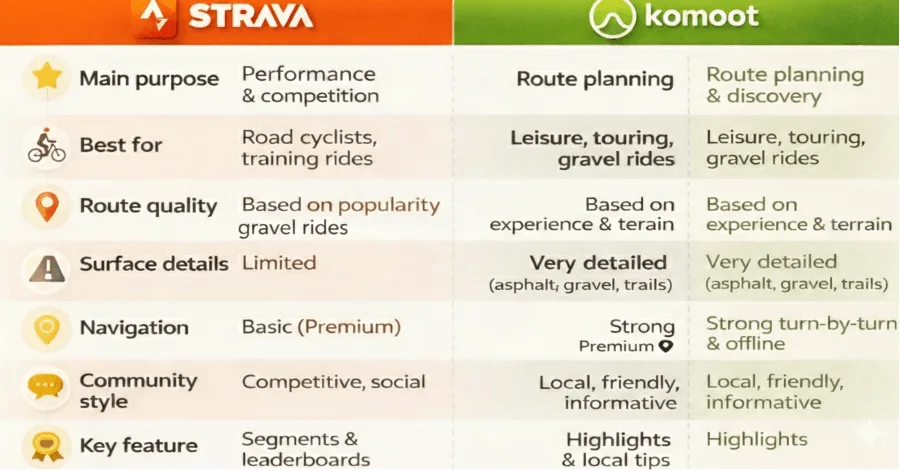
So what should you choose then? Most people use both, you can plan your route on Komoot and upload the recorded GPS data to both since Strava has better and more accurate training analyses and segment competition, because of the amount of users data, or you can plan the route on Strava so that it gives you a clear route plan and then export the GPX file through Komoot to check the trails and get more details about them.
Both apps offer free trials or basic free versions. Test them and see which app clicks with you, but also be aware that route planning can be affected by your geographical location. Apps that work the best in Europe don´t have to be accurate in every part of the world. Komoot tends to be the strongest in Europe, but can be non-reliable in remote areas in the U.S or Canada, so if you are planning a cycling trip on the other side of the world, just keep that in mind and go for other apps such as Ride with GPS or All Trails.
At the end, whatever you choose, the real win is getting out there and riding. The best route planner is the one that actually gets you on the bike and helps you enjoy every kilometre of your journey.