
Why cycling together is more fun than alone
Cycling alone has its charm for many. You determine your own pace, choose exactly when to go, and decide your own route. For some, this freedom is an essential part of the sport. Yet, many cyclists often choose to head out together. That is no coincidence. Cycling in a group offers advantages that go beyond just flexibility and freedom.
But what exactly makes cycling together more fun than alone?
More interaction, fun, and connection
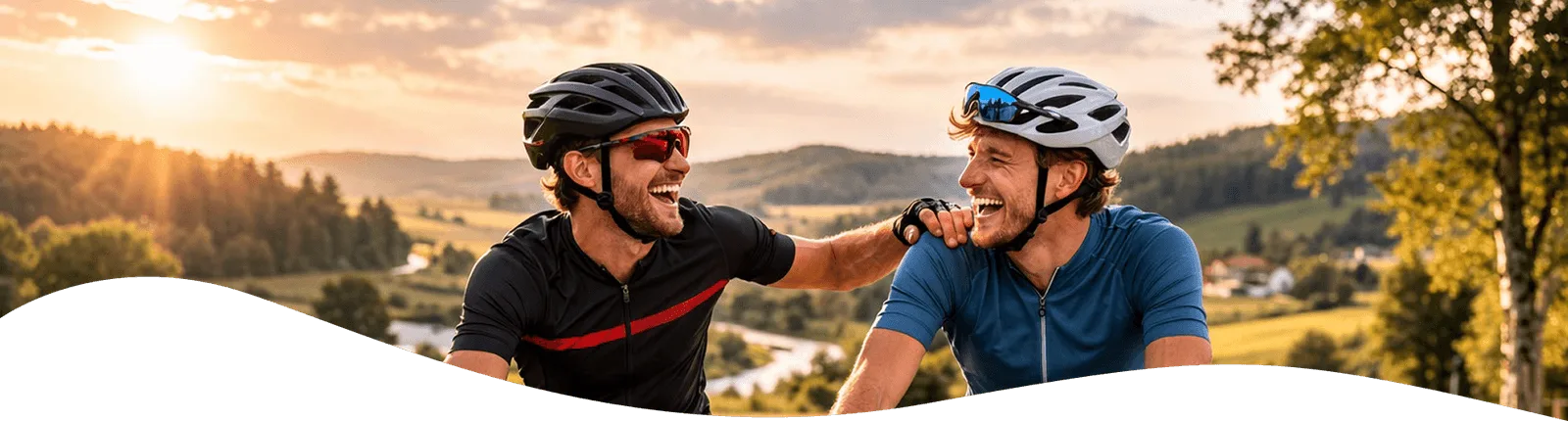
Where you can only be busy with yourself during a solo ride, cycling in a group brings social interaction. You have a chat along the way, discuss how your weekend was, and create moments together that make a ride more than just “a training.”
The conversations arise naturally through: the weekends, potential coffee stops, or a new route that someone wants to try out. All this interaction ensures more fun and connection with each other. You get to know each other better and start to trust each other more. Cycling together therefore becomes not only a sporting activity, but also a social moment that gives you energy.
Group rides that improve your performance
Cycling together stimulates and improves your performance.
You know the feeling, your cycling friend starts half-wheeling, you are triggered and want to overtake him at all costs, you push yourself to the limit. This is exactly what cycling in a group does to you. Because of the company of other cyclists, you’re often consciously or unconsciously competitively triggered. This trigger ensures that you get the maximum out of yourself and you won’t have this when you cycle alone.
Besides the motivation you receive, you can also get tips for your cycling technique. Everyone has their own way of cycling. Riding together offers a good chance to learn from each other by telling your own experiences.
In short: cycling together makes the sport more fun, more social, and often even better.
To keep cycling together fun and safe, it’s smart to make agreements. For example, agree on the route and pace in advance. Cycle with people of the same level, which will ensure a better cycling flow and more fun. Of course, communication is very important: Indicate obstacles, take turns at the lead and be mindful of each other and the traffic around you. This way it remains not only pleasant but also safe.
Essential skills for safe group riding
To safely benefit from drafting (riding in someone’s slipstream), you need to master a few key skills.
It all starts with predictability: always maintain a steady pace and never brake hard or abruptly, as this can cause immediate pile-ups behind you. The standard formation is riding two-abreast (side-by-side), staying as far to the right as possible to leave room for other traffic.
A common mistake is focusing only on the wheel directly in front of you. The trick is to look ahead: look over the shoulder of the rider in front of you to spot potential hazards or obstacles from a distance. It is also important to manage the gap between you and the rider ahead.
As a beginner, you must avoid “half-wheeling“. This happens when your front wheel overlaps with the rear wheel of the person in front of you. If they suddenly have to swerve, your wheels will touch, likely causing a crash.
Once you’ve mastered these basics, you can start learning advanced techniques like the “echelon“
Cycling without much effort
Perhaps the biggest advantage of cycling in a group is the effort you save.
You can cycle longer with the same effort you’d normally put in when riding solo. You might be wondering, “What does he mean by that?” Well, I’m talking about riding in a slipstream. A slipstream means that you ride in the rear wheel of another cyclist. This saves an enormous amount of energy because you catch less wind due to the person in front of you. This allows you to cycle longer with the same effort.
With crosswinds, the echelon effect occurs. Because the wind comes from the side, you can no longer cycle directly behind someone to catch their slipstream. Cyclists therefore ride diagonally behind each other to remain sheltered. The road is simply not wide enough for everyone, so only part of the group can stay out of the wind. The rest will then have to cycle against the wind and thus use more energy. This can cause a peloton to break into multiple groups.
Discovering new routes
It is Sunday morning, your interval session is on the program. There is only one problem: “it‘s raining” does this stop you?
If you have planned this ride alone, probably yes, but in the group there is always someone crazy enough to grab his bike under whatever circumstance.
Additionally, you often cycle the same routes when you ride alone. In a group you discover new roads, different environments, and unexpected routes faster that you might never have chosen yourself. This is therefore not only an investment in the bond you build together, but also in expanding your own map of the area.
Planning and managing group rides clearly via Cyql
Cycling together often starts with two people, but can grow into a large, close-knit group. Questions arise such as: who is coming along, which route are we riding, and what will be the pace? How do we ensure everyone has the same information and that the communication remains clear? Suddenly it is no longer just a ride, but quite a task to arrange everything well.
Cyql helps with this to arrange everything simply and clearly. With Cyql you can plan your rides, share routes, create groups at a distance or for example based on level, and manage your club. This way everyone knows exactly where and when to gather, what the intention of the ride is, and who is going along. You no longer have to puzzle with separate messages and phone calls, everything is in one place.
Moreover, Cyql offers extra benefits for the group. You can look back at previous rides, save favorite routes for later, and discover new routes that other group members have suggested. This way cycling together becomes not only more fun, but also easier and more efficient.
Conclusion: Together stronger than alone
Although cycling alone has advantages, such as complete freedom and determine your own pace, that often does not outweigh what you get from cycling with friends. Cycling together brings energy, motivation, and fun that a solo ride doesn’t give.
Cycling in a group offers:
- More motivation: you get the best out of yourself through the company of your friends
- More fun: rides become social moments, not solo training
- Stronger bond: achieving goals together strengthens the bond with your cycling friends
- New insights: in techniques you learn from each other and discovering new routes